Efe Yarbasi

Efe Yarbasi

Assistant Research Scientist

Efe Yarbasi is an Assistant Research Scientist in the Engineering Systems Group at the University of Michigan Transportation Research Institute (UMTRI). His research covers the safety of automated and driver-assistance systems and the electrification of transportation. He serves as principal investigator and co-principal investigator on projects sponsored by NHTSA, Toyota Motor North America, and the National Cooperative Highway Research Program. He co-leads the Low Altitude Airspace Working Group at M-Air.

He holds a PhD in Aerospace Engineering from Georgia Tech. There he worked in the Aerospace Systems Design Laboratory under Prof. Dimitri Mavris and developed methods to find and reduce the uncertainties that matter most in complex, multi-disciplinary designs. He is a member of AIAA and IEEE.

Students, please get in touch. I am looking for curious, motivated students to join my research. Projects range from crash analysis and AI for safety to EV charging and low-altitude airspace, and I mentor undergraduate and graduate students. If any of this sounds interesting, send me an email with a short note about your background and what you want to work on.

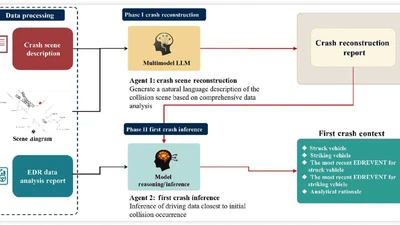
Advanced Tool for Traffic Crash Analysis: An AI-Driven Multi-Agent Approach to Pre-Crash Reconstruction featured image

Advanced Tool for Traffic Crash Analysis: An AI-Driven Multi-Agent Approach to Pre-Crash Reconstruction

A two-phase multi-agent LLM framework that reconstructs pre-crash scenarios from crash reports, scene diagrams, and event data recorder records (277 CISS rear-end crashes).

gerui-xu
•
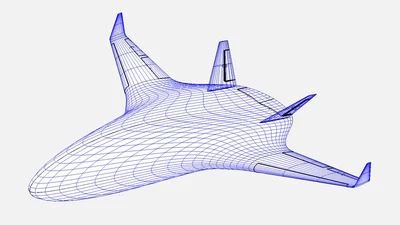
Methodology to Identify Physical or Computational Experiment Conditions for Uncertainty Mitigation featured image

Methodology to Identify Physical or Computational Experiment Conditions for Uncertainty Mitigation

A methodology for designing computational or physical experiments that mitigate system-level uncertainty, demonstrated on an early-stage Blended-Wing-Body aircraft concept.

avatar
Efe Yarbasi
•

Exploring Drivers' Hazardous Action in Two-Vehicle Crashes: A Probabilistic Reasoning Approach Using LLM

A probabilistic reasoning approach using large language models to explore drivers' hazardous actions in two-vehicle crashes.

shan-bao
•
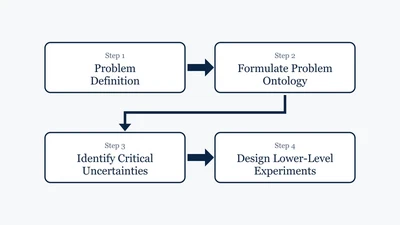
A Methodology for Identifying Experiments for Uncertainty Mitigation in Complex Multi-Disciplinary Design featured image

A Methodology for Identifying Experiments for Uncertainty Mitigation in Complex Multi-Disciplinary Design

A systematic methodology to identify and mitigate epistemic uncertainty in complex, multi-disciplinary aircraft design.

avatar
Efe Yarbasi
•
A Systems Engineering Based Model Selection Approach for Complex, Multi-Disciplinary Physics Problems featured image

A Systems Engineering Based Model Selection Approach for Complex, Multi-Disciplinary Physics Problems

A systems engineering approach to selecting appropriate physics models and fidelity levels for coupled multi-disciplinary simulations.

avatar
Efe Yarbasi
•
A Process for Identifying Requirements for Physical Referent Data to Support Computational Model Validation featured image

A Process for Identifying Requirements for Physical Referent Data to Support Computational Model Validation

A structured process developed under NATO STO AVT-297 for defining physical experiment data requirements to validate computational models.

nigel-j.-taylor
•
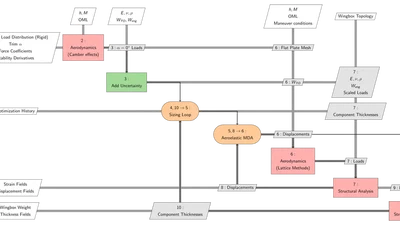
System-Level Identification of Critical Uncertainties to Enable Validation Experiments featured image

System-Level Identification of Critical Uncertainties to Enable Validation Experiments

Identifying the critical system-level uncertainties in a coupled aerostructural analysis to decide which validation experiments to run.

avatar
Efe Yarbasi
•
Operating and Certifying a Net Positive Energy Building During a Pandemic featured image

Operating and Certifying a Net Positive Energy Building During a Pandemic

Operational analysis and digital-twin modeling supporting the Living Building Challenge net-positive energy certification of Georgia Tech's Kendeda Building.

jung-ho-lewe
•

Cistern thermal energy storage study for potential use within net positive energy and water buildings

Modeling and evaluation of underground cistern water tanks as thermal energy storage for net-positive energy and water buildings.

joshua-brooks
•

A Scalable Intra-Network Building Heat Exchange Model for District Cooling Systems

A scalable thermal-fluid network model for simulating building-to-grid heat exchange across campus district cooling loops.

sehwan-oh
•