Intersection Right-of-Way ADAS Technology Assessment
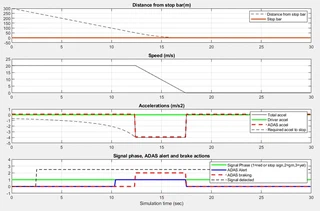 Simulation of an intersection ADAS: the alert and automatic braking bring the vehicle to a stop when the driver does not respond (project report to NHTSA).
Sponsor: National Highway Traffic Safety Administration (NHTSA) · Period: 2024 to 2027
Intersection right-of-way crashes, such as left turns across path and crossing-path collisions, are a growing focus for driver assistance technology. This project assesses intersection right-of-way ADAS, including the risks and unintended consequences such systems could introduce.
My contributions
- Led the Hazard Analysis and Risk Assessment (HARA), applying ISO 26262 functional safety, DFMEA, STPA, and SOTIF methods to identify, analyze, and prioritize risks.
- Organized structured engagement with outside experts from the automotive industry, insurance, law enforcement, crash data and roadway operations, and human factors.

Efe Yarbasi is an Assistant Research Scientist in the Engineering Systems Group at the University of Michigan Transportation Research Institute (UMTRI). His research covers the safety of automated and driver-assistance systems and the electrification of transportation. He serves as principal investigator and co-principal investigator on projects sponsored by NHTSA, Toyota Motor North America, and the National Cooperative Highway Research Program. He co-leads the Low Altitude Airspace Working Group at M-Air.
He holds a PhD in Aerospace Engineering from Georgia Tech. There he worked in the Aerospace Systems Design Laboratory under Prof. Dimitri Mavris and developed methods to find and reduce the uncertainties that matter most in complex, multi-disciplinary designs. He is a member of AIAA and IEEE.
Students, please get in touch. I am looking for curious, motivated students to join my research. Projects range from crash analysis and AI for safety to EV charging and low-altitude airspace, and I mentor undergraduate and graduate students. If any of this sounds interesting, send me an email with a short note about your background and what you want to work on.