Smart Campus
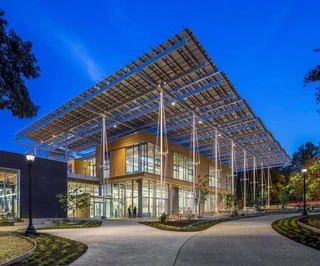 The Kendeda Building. Image: Georgia Tech
Smart Campus was a multi-disciplinary, multi-year research program at Georgia Tech treating the entire campus as a living laboratory by collecting and analyzing high-resolution data from campus energy and utility systems in collaboration with Georgia Tech Facilities Management (GTFM). As a senior graduate researcher on the project, I led teams of graduate and undergraduate students, contributed to grant proposals and statements of work, and led key technical thrusts:
Building Energy & Water Modeling: I developed and calibrated detailed time-dependent digital twin models in MATLAB/Simulink, Dymola, and Python for campus building energy systems using operational metering data. These models were used to evaluate operational strategies, cistern thermal energy storage, and intra-network district cooling heat exchange, including supporting the net-positive energy certification of the Kendeda Building for Innovative Sustainable Design (KBISD) from its pre-construction phase through operation.
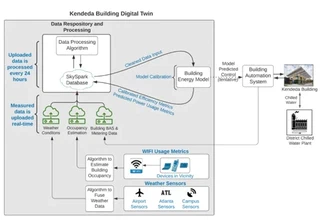
Data Analysis & Anomaly Detection: Processed and validated multi-dimensional, noisy sensor streams from campus utility meters and building automation systems, identifying metering faults and operational anomalies in coordination with Georgia Tech Facilities Management.
Local Weather Fusion & Solar Forecasting: Accurate real-time digital twin predictions require local temperature, precipitation, wind speed, relative humidity, and solar irradiance (global horizontal, direct normal, and diffuse horizontal) rather than typical meteorological year (TMY) profiles. I built automated pipelines and APIs to query and fuse multiple campus and regional weather stations, and trained a neural network on four years of NREL solar data to estimate diffuse horizontal irradiance whenever local sensor measurements were unavailable.

Efe Yarbasi is an Assistant Research Scientist in the Engineering Systems Group at the University of Michigan Transportation Research Institute (UMTRI). His research covers the safety of automated and driver-assistance systems and the electrification of transportation. He serves as principal investigator and co-principal investigator on projects sponsored by NHTSA, Toyota Motor North America, and the National Cooperative Highway Research Program. He co-leads the Low Altitude Airspace Working Group at M-Air.
He holds a PhD in Aerospace Engineering from Georgia Tech. There he worked in the Aerospace Systems Design Laboratory under Prof. Dimitri Mavris and developed methods to find and reduce the uncertainties that matter most in complex, multi-disciplinary designs. He is a member of AIAA and IEEE.
Students, please get in touch. I am looking for curious, motivated students to join my research. Projects range from crash analysis and AI for safety to EV charging and low-altitude airspace, and I mentor undergraduate and graduate students. If any of this sounds interesting, send me an email with a short note about your background and what you want to work on.