A Methodology for Identifying Experiments for Uncertainty Mitigation in Complex Multi-Disciplinary Design

Sep 1, 2023·
Efe Yarbasi
Efe Yarbasi
· 0 min read
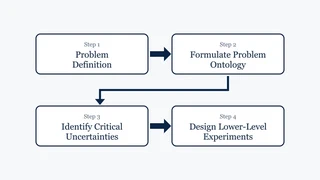
Four-step method: problem definition, problem ontology, critical uncertainties, lower-level experiments
Abstract
The dissertation develops a systematic methodology to identify and mitigate sources of uncertainty in aircraft design, focusing on epistemic uncertainties such as model-form and parameter uncertainties. This approach enhances Systems Engineering by integrating modeling and simulation components and mapping simulation requirements onto a proposed modeling architecture. It addresses the challenge of identifying critical uncertainties in complex, multi-disciplinary aerospace systems through sensitivity analysis, investigating the impact of surrogate modeling and subjectivity in input probability density functions, and addressing the inverse problem for parameter uncertainty allocation. The final focus is on designing computational and physical experiments guided by computational experiments to reduce epistemic uncertainty, converting the full-scale modeling problem into a constrained optimization problem to represent full-scale behavior effectively in reduced-scale physical experiments.
Type
Publication
Doctoral dissertation, Georgia Institute of Technology
Status
Open access
publications
Efe Yarbasi
Authors
Assistant Research Scientist

Efe Yarbasi is an Assistant Research Scientist in the Engineering Systems Group at the University of Michigan Transportation Research Institute (UMTRI). His research covers the safety of automated and driver-assistance systems and the electrification of transportation. He serves as principal investigator and co-principal investigator on projects sponsored by NHTSA, Toyota Motor North America, and the National Cooperative Highway Research Program. He co-leads the Low Altitude Airspace Working Group at M-Air.

He holds a PhD in Aerospace Engineering from Georgia Tech. There he worked in the Aerospace Systems Design Laboratory under Prof. Dimitri Mavris and developed methods to find and reduce the uncertainties that matter most in complex, multi-disciplinary designs. He is a member of AIAA and IEEE.

Students, please get in touch. I am looking for curious, motivated students to join my research. Projects range from crash analysis and AI for safety to EV charging and low-altitude airspace, and I mentor undergraduate and graduate students. If any of this sounds interesting, send me an email with a short note about your background and what you want to work on.