Advanced Tool for Traffic Crash Analysis: An AI-Driven Multi-Agent Approach to Pre-Crash Reconstruction

Mar 31, 2026·
Gerui Xu
,
Boyou Chen
,
Huizhong Guo
Efe Yarbasi
Efe Yarbasi
,
Dave LeBlanc
,
Arpan Kusari
,
Ananna Ahmed
,
Zhaonan Sun
,
Shan Bao
· 0 min read
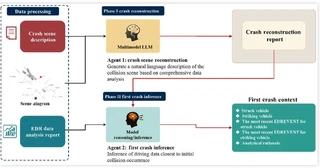
Overview of the multi-agent framework (Figure 1, © 2026 The Authors; published by SAE International).
Abstract
Traffic collision reconstruction traditionally relies on human expertise and, when performed properly, can be incredibly accurate. However, attempting to perform pre-crash reconstruction, i.e., reconstructing the driver and vehicle behaviors that preceded the actual crash, poses significantly more challenges. This study develops a multi-agent artificial intelligence (AI) framework that reconstructs pre-crash scenarios and infers vehicle behaviors from fragmented collision data. We present a two-phase collaborative framework combining reconstruction and reasoning phases. The system processes 277 rear-end lead vehicle deceleration (LVD) collisions from the Crash Investigation Sampling System (CISS; 2017–2022), integrating textual crash reports, structured tabular data, and visual scene diagrams. Phase I generates natural language crash reconstructions from multimodal inputs. Phase II performs in-depth crash reasoning by combining these reconstructions with the temporal event data recorder (EDR). This enables precise identification of striking and struck vehicles while isolating the EDR records most relevant to the collision moment, thereby revealing crucial pre-crash driving behaviors. In the full end-to-end evaluation, the framework achieved 100% accuracy across all 4155 trials (277 cases × 5 runs × 3 models). This zero-shot evaluation, conducted without any domain-specific training or fine-tuning, demonstrates that the framework’s effectiveness stems from its multi-agent architecture and prompt engineering, offering a scalable approach for AI-assisted pre-crash analysis.
Type
Publication
SAE International Journal of Transportation Safety, 14(1)
Status
Peer-reviewed
publications
Efe Yarbasi
Authors
Assistant Research Scientist

Efe Yarbasi is an Assistant Research Scientist in the Engineering Systems Group at the University of Michigan Transportation Research Institute (UMTRI). His research covers the safety of automated and driver-assistance systems and the electrification of transportation. He serves as principal investigator and co-principal investigator on projects sponsored by NHTSA, Toyota Motor North America, and the National Cooperative Highway Research Program. He co-leads the Low Altitude Airspace Working Group at M-Air.

He holds a PhD in Aerospace Engineering from Georgia Tech. There he worked in the Aerospace Systems Design Laboratory under Prof. Dimitri Mavris and developed methods to find and reduce the uncertainties that matter most in complex, multi-disciplinary designs. He is a member of AIAA and IEEE.

Students: I enjoy working with students. If you are interested in my research, please send me an email.